Estrogen and Stroke a Review of the Current Literature
 | |
 | |
| Clinical data | |
|---|---|
| Trade names | Nolvadex, Genox, Tamifen, others[1] |
| Other names | TMX; ICI-46474 |
| AHFS/Drugs.com | Monograph |
| MedlinePlus | a682414 |
| License data |
|
| Pregnancy category |
|
| Routes of assistants | By rima oris |
| Drug class | Selective estrogen receptor modulator |
| ATC code |
|
| Legal condition | |
| Legal status |
|
| Pharmacokinetic data | |
| Bioavailability | ~100%[5] [6] |
| Protein binding | >99% (albumin)[5] [7] |
| Metabolism | Liver (CYP3A4, CYP2C9, CYP2D6)[5] [12] [8] |
| Metabolites | • N-Desmethyltamoxifen[8] [ix] • Endoxifen (4-hydroxy-N-desmethyltamoxifen)[8] [ix] • Afimoxifene (4-hydroxytamoxifen)[8] [ix] • N,Northward-Didesmethyltamoxifen[viii] • Norendoxifen (4-hydroxy-Due north,N-didesmethyltamoxifen)[8] • Others, conjugates[8] [10] [11] |
| Elimination half-life | 5–vii days[five] [viii] |
| Excretion | Carrion: 65% Urine: ix% |
| Identifiers | |
| IUPAC name
| |
| CAS Number |
|
| PubChem CID |
|
| IUPHAR/BPS |
|
| DrugBank |
|
| ChemSpider |
|
| UNII |
|
| KEGG |
|
| ChEBI |
|
| ChEMBL |
|
| PDB ligand |
|
| CompTox Dashboard (EPA) |
|
| ECHA InfoCard | 100.031.004 |
| Chemical and concrete information | |
| Formula | C 26 H 29 N O |
| Molar mass | 371.524 k·mol−ane |
| 3D model (JSmol) |
|
| SMILES
| |
| InChI
| |
| (verify) | |


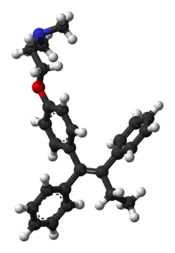
Tamoxifen, sold under the brand proper name Nolvadex amongst others, is a selective estrogen receptor modulator used to prevent breast cancer in women and care for breast cancer in women and men.[thirteen] It is also being studied for other types of cancer.[xiii] It has been used for Albright syndrome.[14] Tamoxifen is typically taken daily by rima oris for five years for breast cancer.[14]
Serious side effects include a small increased risk of uterine cancer, stroke, vision problems, and pulmonary embolism.[14] Common side effects include irregular periods, weight loss, and hot flashes.[14] It may crusade harm to the baby if taken during pregnancy or breastfeeding.[14] It is a selective estrogen-receptor modulator (SERM) and works by decreasing the growth of breast cancer cells.[14] [15] It is a fellow member of the triphenylethylene group of compounds.[16]
Tamoxifen was initially made in 1962, past chemist Dora Richardson.[17] [eighteen] It is on the Globe Health System's Listing of Essential Medicines.[19] Tamoxifen is available as a generic medication.[fourteen] In 2018, it was the 262nd most normally prescribed medication in the United States, with more than than imillion prescriptions.[20] [21]
Medical uses [edit]
Dysmenorrhea [edit]
Tamoxifen has been used effectively to meliorate blood catamenia, reduce uterine contractility and pain in dysmenorrhea patients.[22]
Breast cancer [edit]
Tamoxifen is used for the treatment of both early on and avant-garde estrogen receptor-positive (ER-positive or ER+) breast cancer in pre- and postmenopausal women.[23] Tamoxifen increases the chance of postmenopausal bleeding, endometrial polyps, hyperplasia, and endometrial cancer; using tamoxifen with an intrauterine system releasing levonorgestrel might increase vaginal haemorrhage afterwards 1 to 2 years, but reduces somewhat endometrial polyps and hyperplasia, simply non necessarily endometrial cancer.[137] Additionally, information technology is the most common hormone treatment for male breast cancer.[24] It is as well approved by the FDA for the prevention of chest cancer in women at loftier take chances of developing the affliction.[25] Information technology has been further canonical for the reduction of contralateral (in the reverse breast) cancer. The use of tamoxifen is recommended for 10 years.[26]
In 2006, the large STAR clinical report concluded that raloxifene is also effective in reducing the incidence of breast cancer. Updated results after an average of 6.75 years of follow upward found that raloxifene retains 76% of tamoxifen's effectiveness in preventing invasive breast cancer, with 45% fewer uterine cancers and 25% fewer claret clots in women taking raloxifene than in women taking tamoxifen.[27] [28] [29]
Infertility [edit]
Tamoxifen is used for ovulation induction to treat infertility in women with anovulatory disorders. It is given at days three to 7 of a adult female'southward cycle.[xxx]
Tamoxifen improves fertility in males with infertility by disinhibiting the hypothalamic–pituitary–gonadal centrality (HPG axis) via ER animosity and thereby increasing the secretion of luteinizing hormone (LH) and follicle-stimulating hormone (FSH) and increasing testicular testosterone production.[31]
Gynecomastia [edit]
Tamoxifen is used to prevent and treat gynecomastia.[32] [33] Information technology is taken as a preventative measure in small-scale doses, or used at the onset of any symptoms such as nipple soreness or sensitivity. Other medications are taken for similar purposes such as clomifene and the anti-aromatase drugs which are used in order to endeavour to avoid the hormone-related adverse effects.
| Follow-up timepoint | Tamoxifen dosage | |||||
|---|---|---|---|---|---|---|
| Placebo | 1 mg/day | 2.v mg/day | five mg/day | 10 mg/day | 20 mg/twenty-four hours | |
| 0 months | – | |||||
| vi months | 98% | 90% | eighty% | 54% | 22% | 10% |
| 12 months | 99% | 95% | 84% | 56% | 38% | 19% |
| Notes: Prevention of breast symptoms—specifically gynecomastia and breast pain—induced by 150 mg/day bicalutamide monotherapy with tamoxifen in 282 men with prostate cancer. Bicalutamide and tamoxifen were initiated at the aforementioned time (0 months). Estradiol levels were in the range of nigh 22 to 47 pg/mL in the treated group.[34] Sources: [35] [34] | ||||||
Early puberty [edit]
Tamoxifen is useful in the treatment of peripheral precocious puberty, for instance due to McCune–Albright syndrome, in both girls and boys.[36] [37] [38] It has been found to decrease growth velocity and the rate of os maturation in girls with precocious puberty, and hence to meliorate final height in these individuals.[36] [37]
Bachelor forms [edit]

Nolvadex (tamoxifen) 20 mg tablets.
Tamoxifen is available every bit a tablet or oral solution.[39] [twoscore]
Contraindications [edit]
Tamoxifen has a number of contraindications, including known hypersensitivity to tamoxifen or other ingredients, individuals taking concomitant coumarin-type anticoagulant therapy, and women with a history of venous thromboembolism (deep vein thrombosis or pulmonary embolism).[12]
Side effects [edit]
A report in September 2009 from Health and Human Services' Bureau for Healthcare Research and Quality suggests that tamoxifen, raloxifene, and tibolone used to treat breast cancer significantly reduce invasive breast cancer in midlife and older women, just also increase the risk of agin side effects.[41]
Endometrial cancer [edit]
Tamoxifen is a selective estrogen receptor modulator (SERM).[42] Even though information technology is an antagonist in breast tissue information technology acts as partial agonist on the endometrium and has been linked to endometrial cancer in some women. Therefore, endometrial changes, including cancer, are among tamoxifen'southward side effects.[43] With time, risk of endometrial cancer may be doubled to quadrupled, which is a reason tamoxifen is typically merely used for five years.[44]
The American Cancer Society lists tamoxifen equally a known carcinogen, stating that it increases the risk of some types of uterine cancer while lowering the adventure of breast cancer recurrence.[45]
Cardiovascular and metabolic [edit]
Tamoxifen treatment of postmenopausal women is associated with beneficial effects on serum lipid profiles. Even so, long-term information from clinical trials take failed to demonstrate a cardioprotective effect.[46] For some women, tamoxifen can cause a rapid increase in triglyceride concentration in the blood. In addition, at that place is an increased risk of thromboembolism especially during and immediately after major surgery or periods of immobility.[47] Employ of tamoxifen has been shown to slightly increase risk of deep vein thrombosis, pulmonary embolism, and stroke.[48]
Liver toxicity [edit]
Tamoxifen has been associated with a number of cases of hepatotoxicity.[49] Several different varieties of hepatotoxicity have been reported.[49] Tamoxifen can likewise precipitate non-alcoholic fatty liver disease in obese and overweight women (not in normal weight women) at an average charge per unit of 40% after a year use with 20 mg/24-hour interval.[l]
Overdose [edit]
Acute overdose of tamoxifen has non been reported in humans.[12] In dose-ranging studies, tamoxifen was administered at very high doses in women (e.g., 300 mg/mii) and was found to produce acute neurotoxicity including tremor, hyperreflexia, unsteady gait, and dizziness.[12] These symptoms occurred within 3 to 5 days of therapy and disappeared inside two to five days of discontinuation of therapy.[12] No indications of permanent neurotoxicity were observed.[12] QT prolongation was also observed with very high doses of tamoxifen.[12] There is no specific antidote for overdose of tamoxifen.[12] Instead, treatment should exist based on symptoms.[12]
Interactions [edit]
Patients with variant forms of the gene CYP2D6 may not receive full benefit from tamoxifen because of too slow metabolism of the tamoxifen prodrug into its active metabolites.[51] [52] On 18 Oct 2006, the Subcommittee for Clinical Pharmacology recommended relabeling tamoxifen to include information most this cistron in the parcel insert.[53] Certain CYP2D6 variations in breast cancer patients atomic number 82 to a worse clinical outcome for tamoxifen treatment.[54] Genotyping therefore has the potential for identification of women who have these CYP2D6 phenotypes and for whom the utilize of tamoxifen is associated with poor outcomes. Recent research has shown that vii–10% of women with breast cancer may not receive the total medical do good from taking tamoxifen due to their genetic brand-up. DNA Drug Prophylactic Testing can examine DNA variations in the CYP2D6 and other important drug processing pathways. More than than xx% of all clinically used medications are metabolized by CYP2D6 and knowing the CYP2D6 condition of a person can help the doctor with the future selection of medications.[55] Other molecular biomarkers may also be used to select appropriate patients likely to benefit from tamoxifen.[56]
Recent studies suggest that taking the selective serotonin reuptake inhibitors (SSRIs) antidepressants paroxetine (Paxil), fluoxetine (Prozac), and sertraline (Zoloft) can decrease the effectiveness of tamoxifen, as these drugs compete for the CYP2D6 enzyme which is needed to metabolize tamoxifen into its active forms.[57] A U.S. report presented at the American Society of Clinical Oncology's annual coming together in 2009 found that after two years, 7.five% of women who took only tamoxifen had a recurrence, compared with sixteen% who took either paroxetine, fluoxetine or sertraline, drugs considered to be the most stiff CYP2D6 inhibitors. That difference translates to a 120% increment in the risk of breast cancer recurrence. Patients taking the SSRIs; Celexa (citalopram), Lexapro (escitalopram), and Luvox (fluvoxamine), did not have an increased run a risk of recurrence, due to their lack of competitive metabolism for the CYP2D6 enzyme.[58] A newer study demonstrated a clearer and stronger effect from paroxetine in causing the worst outcomes. Patients treated with both paroxetine and tamoxifen have a 67% increased adventure of death from breast cancer, from 24% to 91%, depending on the duration of coadministration.[59]
Tamoxifen interacts with certain other antiestrogens.[5] The aromatase inhibitor aminoglutethimide induces the metabolism of tamoxifen.[5] Conversely, the aromatase inhibitor letrozole does not affect the metabolism of tamoxifen.[v] Nonetheless, tamoxifen induces the metabolism of letrozole and significantly reduces its concentrations.[5]
Pharmacology [edit]
Pharmacodynamics [edit]
Selective estrogen receptor modulator activeness [edit]

Tamoxifen acts equally a selective estrogen receptor modulator (SERM), or as a fractional agonist of the estrogen receptors (ERs). Information technology has mixed estrogenic and antiestrogenic activity, with its profile of furnishings differing past tissue. For instance, tamoxifen has predominantly antiestrogenic effects in the breasts but predominantly estrogenic furnishings in the uterus and liver. In breast tissue, tamoxifen acts as an ER antagonist so that transcription of estrogen-responsive genes is inhibited.[61] A beneficial side result of tamoxifen is that it prevents bone loss by acting as an ER agonist (i.e., mimicking the effects of estrogen) in this prison cell blazon. Therefore, by inhibiting osteoclasts, it prevents osteoporosis.[62] [63] When tamoxifen was launched every bit a drug, information technology was thought that tamoxifen would act every bit an ER antagonist in all tissues, including bone, and therefore it was feared that it would contribute to osteoporosis. It was therefore very surprising that the contrary outcome was observed clinically. Hence tamoxifen'due south tissue selective action directly led to the formulation of the concept of SERMs.[64]
| Medication | Breast | Bone | Liver | Uterus | Vagina | Encephalon | ||||||||
|---|---|---|---|---|---|---|---|---|---|---|---|---|---|---|
| Lipids | Coagulation | SHBG | IGF-1 | Hot flashes | Gonadotropins | |||||||||
| Estradiol | + | + | + | + | + | + | + | + | + | + | ||||
| "Ideal SERM" | – | + | + | ± | ± | ± | – | + | + | ± | ||||
| Bazedoxifene | – | + | + | + | + | ? | – | ± | – | ? | ||||
| Clomifene | – | + | + | ? | + | + | – | ? | – | ± | ||||
| Lasofoxifene | – | + | + | + | ? | ? | ± | ± | – | ? | ||||
| Ospemifene | – | + | + | + | + | + | ± | ± | – | ± | ||||
| Raloxifene | – | + | + | + | + | + | ± | – | – | ± | ||||
| Tamoxifen | – | + | + | + | + | + | + | – | – | ± | ||||
| Toremifene | – | + | + | + | + | + | + | – | – | ± | ||||
| Effect: + = Estrogenic / agonistic. ± = Mixed or neutral. – = Antiestrogenic / antagonistic. Note: SERMs generally increment gonadotropin levels in hypogonadal and eugonadal men as well as premenopausal women (antiestrogenic) but subtract gonadotropin levels in postmenopausal women (estrogenic). Sources: See template. | ||||||||||||||
Tamoxifen is a long-acting SERM, with a nuclear retention of the ER–tamoxifen (or metabolite) complex of greater than 48 hours.[65] [66] It has relatively picayune affinity for the ERs itself and instead acts every bit a prodrug of agile metabolites such as endoxifen (4-hydroxy-N-desmethyltamoxifen) and afimoxifene (4-hydroxytamoxifen; four-OHT).[9] These metabolites have approximately 30 to 100 times greater analogousness for the ERs than tamoxifen itself.[8] [67] Per ane study, tamoxifen had 7% and 6% of the affinity of estradiol for the ERα and ERβ, respectively, whereas afimoxifene had 178% and 338% of the affinity of estradiol for the ERα and ERβ, respectively.[68] Hence, afimoxifene showed 25-fold higher analogousness for the ERα and 56-fold college analogousness for the ERβ than tamoxifen.[69] The antiestrogenic potencies of endoxifen and afimoxifene are very similar.[nine] However, endoxifen occurs in much higher concentrations than afimoxifene and is at present idea to be the major active form of tamoxifen in the body.[8] [ix] [70]
Tamoxifen binds to ER competitively (with respect to the endogenous agonist estrogen) in tumor cells and other tissue targets, producing a nuclear circuitous that decreases Deoxyribonucleic acid synthesis and inhibits estrogen effects. It is a nonsteroidal agent with potent antiestrogenic backdrop which compete with estrogen for binding sites in chest and other tissues. Tamoxifen causes cells to remain in the G0 and G1 phases of the cell cycle. Because it prevents (pre)cancerous cells from dividing just does non cause cell death, tamoxifen is cytostatic rather than cytocidal. Tamoxifen binds to ER, the ER/tamoxifen complex recruits other proteins known as co-repressors, and the complex then binds to Dna to attune gene expression. Some of these proteins include NCoR and SMRT.[71] Tamoxifen part can exist regulated by a number of dissimilar variables including growth factors.[72] Tamoxifen needs to block growth factor proteins such as ErbB2/HER2[73] considering high levels of ErbB2 have been shown to occur in tamoxifen resistant cancers.[74] Tamoxifen seems to require a protein PAX2 for its full anticancer effect.[73] [75] In the presence of high PAX2 expression, the tamoxifen/ER circuitous is able to suppress the expression of the pro-proliferative ERBB2 protein. In contrast, when AIB-ane expression is higher than PAX2, tamoxifen/ER complex upregulates the expression of ERBB2 resulting in stimulation of breast cancer growth.[73] [76]
Tamoxifen is antigonadotropic in postmenopausal women and partially suppresses levels of the gonadotropins, luteinizing hormone (LH) and follicle-stimulating hormone (FSH) in such women.[77] However, it has progonadotropic furnishings in premenopausal women and increases estrogen levels by six-fold in them.[77] Due to the nature of tamoxifen as a competitive ER ligand, this increment in estrogen levels is liable to interfere with the antiestrogenic efficacy of tamoxifen.[77] The furnishings of tamoxifen on breast cancer Ki-67 expression, sex hormone-binding globulin (SHBG) levels, and IGF-1 levels are dose-dependent beyond a dosage range of i to 20 mg/mean solar day in women with breast cancer.[78] Tamoxifen has been found to decrease insulin-like growth gene 1 (IGF-1) levels by 17 to 38% in women and men.[79] Suppression of IGF-1 production in the liver is a well-known action of estrogens and SERMs.[79] A x mg/day dosage of tamoxifen is about as effective as a 20 mg/day dosage in suppressing IGF-1 levels.[5]
Other activities [edit]
Afimoxifene is an agonist of the K poly peptide-coupled estrogen receptor (GPER) with relatively low affinity.[80] Its affinity for the receptor is in the range of 100 to i,000 nM, relative to three to 6 nM for estradiol.[eighty]
In addition to its activity as a SERM, afimoxifene binds to both the estrogen-related receptor β and estrogen-related receptor γ and is an antagonist of the estrogen-related receptor γ (ERRγ).[81]
Norendoxifen (4-hydroxy-N,Northward-didesmethyltamoxifen), another active metabolite of tamoxifen, has been establish to human action as a potent competitive aromatase inhibitor (ICfifty = 90 nM), and may also exist involved in the antiestrogenic activity of tamoxifen.[82]
In improver to its action equally a SERM, tamoxifen is a potent and selective poly peptide kinase C inhibitor, and is active in this regard at therapeutic concentrations.[83] This action is thought to underlie the efficacy of tamoxifen in the treatment of bipolar disorder.[83]
Tamoxifen is an inhibitor of P-glycoprotein.[12]
Pharmacokinetics [edit]
Absorption [edit]
Tamoxifen is quickly and extensively absorbed from the intestines with oral administration.[5] [6] The oral bioavailability of tamoxifen is approximately 100%, which is suggestive of minimal offset-pass metabolism in the intestines and liver.[5] Post-obit intake, peak levels of tamoxifen occur after three to seven hours.[84] [v] Steady country levels of tamoxifen are reached typically after 3 to 4 weeks but possibly up to 16 weeks of daily administration.[5] [11] Steady state levels of afimoxifene are accomplished after 8 weeks of daily tamoxifen assistants.[xi] [seven] Tiptop levels of tamoxifen after a single 40 mg oral dose were 65 ng/mL and steady state levels at 20 mg/day were 310 ng/mL.[5] Levels of tamoxifen show articulate dose dependency across a dosage range of 1 to 20 mg/day.[5] [85] Endoxifen levels are approximately 5 to 10 times higher than afimoxifene levels, with large interindividual variability.[viii] [9] Endoxifen levels have been reported as 10.8 to 15.9 ng/mL at steady state in CYP2D6 normal metabolizers during therapy with 20 mg/day tamoxifen.[8] The near abundant metabolites of tamoxifen in terms of circulating concentrations are Northward-desmethyltamoxifen, North,Due north-didesmethyltamoxifen, (Z)-endoxifen, and tamoxifen N-oxide.[10] [86]
Distribution [edit]
The volume of distribution of tamoxifen is 50 to 60 L/kg and its clearance has been estimated every bit i.2 to v.1 L/hour.[5] [84] High concentrations of tamoxifen take been found in breast, uterus, liver, kidney, lung, pancreas, and ovary tissue in animals and humans.[5] Levels of tamoxifen in the uterus have been found to be ii- to 3-fold college than in the apportionment[5] and in the breasts x-fold higher than in the circulation.[85] The plasma protein binding of tamoxifen and afimoxifene is greater than 99%.[seven] A majority of tamoxifen is leap to albumin.[5] Albumin alone binds 98.8% of tamoxifen while other plasma proteins are non greatly involved.[87]
Metabolism [edit]
| Compound | Hateful plasma concentrations | Effect on ER / affinity for ERa |
|---|---|---|
| Tamoxifen | 190–420 nmol/L | Weak adversary / two% |
| N-Desmethyltamoxifen | 280–800 nmol/Fifty | Weak antagonist / ane% |
| N,Northward-Desmethyltamoxifen | ninety–120 nmol/50 | Weak antagonist |
| Endoxifen | 14–130 nmol/L | Strong antagonist / equal to afimoxifene |
| Afimoxifene | 3–17 nmol/Lb | Strong antagonist / 188% |
| α-Hydroxytamoxifen | 1 nmol/50 | None |
| three,4-Dihydroxytamoxifen | ? | Weak antagonist / high affinity |
| Tamoxifen N-oxide | fifteen–24 nmol/L | Weak adversaryc |
| Footnotes: a = Estradiol is 100%. b = One study reported a much college concentration (67 nmol/L). c = Might be due to reduction to tamoxifen. | ||
Tamoxifen is a prodrug and is metabolized in the liver by the cytochrome P450 isoforms CYP3A4, CYP2C9, and CYP2D6 into active metabolites such as endoxifen (4-hydroxy-N-desmethyltamoxifen) and afimoxifene (4-hydroxytamoxifen).[5] [12] [eight] Conversion of tamoxifen by Due north-demethylation into N-desmethyltamoxifen, which is catalyzed primarily by CYP3A4 and CYP3A5, is responsible for approximately 92% of tamoxifen metabolism.[9] Conversely, four-hydroxylation of tamoxifen into afimoxifene is responsible for but about 7% of tamoxifen metabolism.[9] Following its germination, North-desmethyltamoxifen is oxidized into several other metabolites, the most notable of which is endoxifen.[nine] Some other active metabolite, norendoxifen (four-hydroxy-N,N-didesmethyltamoxifen), is formed via N-demethylation of endoxifen or 4-hydroxylation of Northward,Due north-didesmethyltamoxifen.[8] Tamoxifen and its metabolites undergo conjugation, including glucuronidation and sulfation.[11] Tamoxifen may inhibit its own metabolism.[v]
Elimination [edit]
Tamoxifen has a long elimination half-life of typically 5 to 7 days, with a range of iv to 11 days.[5] [8] [84] Similarly, the one-half-life of afimoxifene is 14 days.[7] Conversely, the half-life of endoxifen is 50 to 70 hours (two–3 days).[8] The long half-lives of tamoxifen and afimoxifene are attributed to their high plasma protein bounden as well as to enterohepatic recirculation.[seven] Upon discontinuation of treatment, levels of tamoxifen and its metabolites persist in the circulation for at least 6 weeks.[vii] Tamoxifen is excreted in bile and is eliminated in carrion, while small amounts are eliminated in urine.[five]
Chemistry [edit]
Tamoxifen is a nonsteroidal SERM of the triphenylethylene family and was structurally derived from diethylstilbestrol-like estrogens and antiestrogens such as chlorotrianisene and ethamoxytriphetol.[89] [90] [91] [92] Initially, clomifene was synthesized, and tamoxifen was developed subsequently.[89] [91] [92] Tamoxifen is closely related structurally to other triphenylethylenes, such as clomifene, nafoxidine, ospemifene, toremifene, and numerous others.[93] [94] Other SERMs, like raloxifene, are structurally distinct from tamoxifen and other triphenylethylenes.[94]
History [edit]
In the late 1950s, pharmaceutical companies were actively researching a newly discovered class of anti-estrogen compounds in the hope of developing a morn-after contraceptive pill. Arthur 50 Walpole was a reproductive endocrinologist who led such a team at the Alderley Park research laboratories of ICI Pharmaceuticals.[18] Information technology was at that place in 1962 that chemist Dora Richardson showtime synthesized tamoxifen, back then known as ICI-46,474, when she was looking to create triphenylethylene derivatives for the contraceptive pill project that her team was researching.[95]
This chemical compound was originally created to work as an estrogen inhibitor, but instead was found to stimulate ovulation in participants of the drug testing trial.[17] Walpole and his colleagues filed a Uk patent covering this compound in 1962, but patent protection on this compound was repeatedly denied in the US until the 1980s.[96] Tamoxifen did eventually receive marketing approval as a fertility treatment, merely the class of compounds never proved useful in human contraception. A link betwixt estrogen and breast cancer had been known for many years, merely cancer treatments were non a corporate priority at the time, and Walpole's personal interests were of import in keeping back up for the compound alive in the face of this and the lack of patent protection.[18] It was merely when Walpole threatened to leave his position that corporate decided to let trials and testing for Tamoxifen every bit a drug that could be used to treat breast cancer. Without Walpole'south effort towards defending the work that his team had done in discovering a maybe revolutionary source for breast cancer treatment, Tamoxifen could have become a discarded or under-researched thought. Walpole's squad consisted of Dora Richardson and G.A. Snow, who worked on the chemistry portion of the project, forth with G.E. Paget and J.K. Walley, who focused primarily on the biological side.[17]
Tamoxifen is i of iii drugs in an anti-angiogenetic protocol developed by Dr. Judah Folkman, a researcher at Children'due south Hospital at Harvard Medical School in Boston. Folkman discovered in the 1970s that angiogenesis – the growth of new claret vessels – plays a significant role in the evolution of cancer. Since his discovery, an entirely new field of cancer research has developed. Clinical trials on angiogenesis inhibitors have been underway since 1992 using many different drugs. The Harvard researchers developed a specific protocol for a golden retriever named Navy who was cancer-complimentary after receiving the prescribed cocktail of celecoxib, doxycycline, and tamoxifen – the handling subsequently became known every bit the Navy Protocol.[97] Furthermore, tamoxifen treatment alone has been shown to have anti-angiogenetic effects in animal models of cancer which appear to be, at least in part, contained of tamoxifen's ER antagonist properties.[98]
Other antiestrogens, such equally ethamoxytriphetol (MER-25) and clomifene (MRL-41), were assessed for treatment of breast cancer and found to be effective before tamoxifen, but were plagued with toxicity issues.[99] [100] The beginning clinical report of tamoxifen took place at the Christie Hospital in 1971, and showed a convincing upshot in advanced breast cancer, only nevertheless ICI'south development program came close to termination when it was reviewed in 1972.[101] In an unpublished article from the early days of the trial, Dora Richardson documented her squad'due south excitement virtually tamoxifen's effects in counteracting infertility problems and the early on positive effects found in breast cancer patients. Unfortunately, this work was not well received by everyone, every bit the squad was supposed to exist looking for a contraceptive pill.[17] Tamoxifen's farther development may take been bolstered by a second clinical study by Harold West.C. Ward [102] at the Queen Elizabeth Hospital, Birmingham. Ward's written report showed a more definitive response to the drug at a higher dosage. Walpole also may have helped to convince the company to market tamoxifen for late stage breast cancer in 1973.[96] He was also instrumental in funding V. Craig Hashemite kingdom of jordan to work on tamoxifen. In 1972, ICI Pharmaceuticals Partition abandoned development of tamoxifen for financial reasons. The drug was later on reinvented from a failed contraceptive, to get tamoxifen, the gold standard for the adjuvant treatment of breast cancer and the pioneering medicine for chemprevention for loftier risk women.[103] [104] Ii books, Estrogen Action, Selective Estrogen Receptor Modulators and Women's Wellness (Imperial College Press 2013) and Tamoxifen Pioneering Medicine in Breast Cancer (Springer 2013) tell this story.
| Antiestrogen | Dosage | Year(southward) | Response charge per unit | Toxicity |
|---|---|---|---|---|
| Ethamoxytriphetol | 500–4,500 mg/day | 1960 | 25% | Acute psychotic episodes |
| Clomifene | 100–300 mg/mean solar day | 1964–1974 | 34% | Fears of cataracts |
| Nafoxidine | 180–240 mg/twenty-four hour period | 1976 | 31% | Cataracts, ichthyosis, photophobia |
| Tamoxifen | 20–40 mg/day | 1971–1973 | 31% | Transient thrombocytopeniaa |
| Footnotes: a = "The item advantage of this drug is the low incidence of troublesome side effects (25)." "Side furnishings were commonly trivial (26)." Sources: [99] [105] | ||||
1980 saw the publication of the first trial to show that tamoxifen given in add-on to chemotherapy improved survival for patients with early on chest cancer.[106] In avant-garde affliction, tamoxifen is now only recognized as constructive in ER+ patients, only the early trials did non select ER+ patients, and by the mid 1980s the clinical trial picture was non showing a major advantage for tamoxifen.[107] Nevertheless, tamoxifen had a relatively mild side-event contour, and a number of large trials continued.
The pharmacology of SERMs was discovered, defined, and deciphered during the 1980s [108] A clinical strategy was described [109] that led to the creation of SERMs every bit a group of multifunctional medicines aimed at the treatment or prevention of many weather in postmenopausal women, eastward.1000. osteoporosis and chest cancer. This story is told in: Five. Craig Hashemite kingdom of jordan, ed. 2013. "Estrogen Action, Selective Estrogen Receptor Modulators and Women's Health" Purple Higher Printing, Singapore.
The early sales of tamoxifen in both the UK and in the U.Southward. far exceeded ICI's original estimate, simply despite this, at the almanac portfolio review ICI's board members withal asserted that "in that location was no marketplace for cancer", leaving the drug's marketing success to rely on its clinical results and clinicians and scientists interests in it. Shortly subsequently, Dora Richardson published a history of Tamoxifen that, unusually for that type of paper, included personal accounts and letters from patients who attributed their healing to the drug. It is by giving vox to cancer patients using Tamoxifen, and so helping to push it forward, by justifying it both morally and scientifically to corporations.[17]
It was not until 1998 that the meta-assay of the Oxford-based Early on Breast Cancer Trialists' Collaborative Group showed definitively that tamoxifen was effective for early breast cancer.[110]
Society and culture [edit]
Brand names [edit]
Tamoxifen is marketed under the brand names Nolvadex and Soltamox, and a diversity of other make names throughout the world.[i] [111]
Economics [edit]
Global sales of tamoxifen in 2001 were approximately $i.02 billion.[112] Since the expiration of the patent in 2002, information technology is widely bachelor as a generic drug around the earth. As of 2004[update], tamoxifen was the world'south largest selling hormonal drug for the treatment of breast cancer.[113]
Research [edit]
In McCune-Albright syndrome (MAS) tamoxifen has been used to care for premature puberty and the consequences of premature puberty. Tamoxifen has been seen to decrease rapid bone maturation which is the consequence of excessive estrogen and alter predicted adult superlative (PAH).[114] [115] The same effects take as well been seen in short pubertal boys.[116] Withal, one in vitro written report in 2007 and later an in vivo study in 2008 take shown that tamoxifen induces apoptosis in growth plate chondrocytes, reduces serum insulin-like growth factor ane (IGF-i) levels and causes persistent retardation of longitudinal and cortical radial bone growth in young male person rats, leading the researchers to limited concern giving tamoxifen to growing individuals.[117] [118]
Tamoxifen has been studied in the treatment of the rare weather condition of retroperitoneal fibrosis[119] and idiopathic sclerosing mesenteritis.[120] Information technology has also been proposed every bit office of a treatment plan for Riedel'due south thyroiditis.[121]
Tamoxifen is used as a inquiry tool to trigger tissue-specific gene expression in many provisional expression constructs in genetically modified animals including a version of the Cre-Lox recombination technique.[122] While widely used in transgenic research, the strong anabolic effect of Tamoxifen on bone might confound this approach, especially equally it relates to bone-targeted constructs.
Tamoxifen may be effective in the treatment of mania in people with bipolar disorder.[123] This is thought to be due to blockade of poly peptide kinase C (PKC), an enzyme that regulates neuron activeness in the brain.[123] [124] Researchers believe PKC is overactive during the mania in bipolar patients.[123] [124] As of September 2019[update], endoxifen, a major active metabolite of tamoxifen with a 4-fold more potent PKC inhibition, was in phase Three clinical trials for bipolar disorder.[125] [126]
References [edit]
- ^ a b "NCI Drug Dictionary". 2011-02-02. Archived from the original on 8 December 2015. Retrieved 12 September 2021.
- ^ "Tamoxifen Employ During Pregnancy". Drugs.com. 25 July 2019. Retrieved 27 January 2020.
- ^ "Tamoxifen citrate tablet, film coated". DailyMed . Retrieved 12 September 2021.
- ^ "Soltamox- tamoxifen citrate liquid". DailyMed . Retrieved 12 September 2021.
- ^ a b c d e f g h i j 1000 l grand due north o p q r s t u v westward Morello KC, Wurz GT, DeGregorio MW (2003). "Pharmacokinetics of selective estrogen receptor modulators". Clinical Pharmacokinetics. 42 (4): 361–72. doi:ten.2165/00003088-200342040-00004. PMID 12648026. S2CID 13003168.
- ^ a b George M. Brenner; Craig Stevens (28 September 2017). Brenner and Stevens' Pharmacology E-Book. Elsevier Wellness Sciences. pp. 394–. ISBN978-0-323-39172-half-dozen.
- ^ a b c d e f Bruce A. Chabner; Dan Fifty. Longo (seven December 2011). Cancer Chemotherapy and Biotherapy: Principles and Practice. Lippincott Williams & Wilkins. pp. 655–. ISBN978-i-4511-4820-vi.
- ^ a b c d e f chiliad h i j 1000 fifty 1000 n o p Sanchez-Spitman AB, Swen JJ, Dezentje VO, Moes DJ, Gelderblom H, Guchelaar HJ (June 2019). "Clinical pharmacokinetics and pharmacogenetics of tamoxifen and endoxifen". Proficient Review of Clinical Pharmacology. 12 (six): 523–536. doi:10.1080/17512433.2019.1610390. PMID 31008668.
- ^ a b c d east f g h i j Klein DJ, Thorn CF, Desta Z, Flockhart DA, Altman RB, Klein TE (Nov 2013). "PharmGKB summary: tamoxifen pathway, pharmacokinetics". Pharmacogenet Genomics. 23 (11): 643–7. doi:10.1097/FPC.0b013e3283656bc1. PMC4084801. PMID 23962908.
- ^ a b Mürdter TE, Schroth W, Bacchus-Gerybadze Fifty, Winter S, Heinkele Chiliad, Simon W, Fasching PA, Fehm T, Eichelbaum M, Schwab M, Brauch H (May 2011). "Activity levels of tamoxifen metabolites at the estrogen receptor and the bear on of genetic polymorphisms of phase I and II enzymes on their concentration levels in plasma". Clin Pharmacol Ther. 89 (five): 708–17. doi:10.1038/clpt.2011.27. PMID 21451508. S2CID 20082053.
- ^ a b c d Nagar S (2010). "Pharmacokinetics of anti-cancer drugs used in breast cancer chemotherapy". Advances in Experimental Medicine and Biology. 678: 124–32. doi:10.1007/978-1-4419-6306-2_16. ISBN978-1-4419-6305-five. PMID 20738014. S2CID 12537667.
- ^ a b c d e f g h i j k "Nolvadex (Tamoxifen Citrate) tablets". DailyMed. three November 2016. Retrieved 12 September 2021.
- ^ a b "Tamoxifen Citrate". NCI. August 26, 2015. Archived from the original on 4 January 2016. Retrieved 28 November 2015.
- ^ a b c d eastward f 1000 "Tamoxifen Citrate". The American Order of Wellness-Arrangement Pharmacists. Archived from the original on 2014-01-04. Retrieved 27 Nov 2015.
- ^ "Selective estrogen receptor modulators". Archived from the original on 9 Dec 2013. Retrieved 28 Nov 2015.
- ^ Cano A, Calaf i Alsina J, Duenas-Diez JL, eds. (2006). Selective Estrogen Receptor Modulators a New Brand of Multitarget Drugs. Berlin, Heidelberg: Springer-Verlag Berlin Heidelberg. p. 52. ISBN9783540347422.
- ^ a b c d east Quirke VM (12 Sep 2017). "Tamoxifen from Failed Contraceptive Pill to Acknowledged Breast Cancer Medicine: A Case-Study in Pharmaceutical Innovation". Frontiers in Pharmacology. viii: 620. doi:10.3389/fphar.2017.00620. PMC5600945. PMID 28955226.
- ^ a b c Jordan VC (January 2006). "Tamoxifen (ICI46,474) as a targeted therapy to treat and prevent breast cancer". British Periodical of Pharmacology. 147 Suppl 1 (Suppl 1): S269-76. doi:10.1038/sj.bjp.0706399. PMC1760730. PMID 16402113.
- ^ World Health Organization (2019). World Health System model list of essential medicines: 21st list 2019. Geneva: World Wellness Organization. hdl:10665/325771. WHO/MVP/EMP/IAU/2019.06. License: CC BY-NC-SA 3.0 IGO.
- ^ "The Top 300 of 2021". ClinCalc . Retrieved 18 February 2021.
- ^ "Tamoxifen Citrate - Drug Usage Statistics". ClinCalc. Archived from the original on 22 September 2020. Retrieved eighteen Feb 2021.
- ^ Thomas B, Magos A (2009). "Modernistic management of dysmenorrhoea". Trends in Urology, Gynaecology & Sexual Health. 14 (v): 25–29. doi:10.1002/tre.120.
- ^ Jordan VC (October 1993). "Fourteenth Gaddum Memorial Lecture. A electric current view of tamoxifen for the handling and prevention of chest cancer". British Journal of Pharmacology. 110 (2): 507–17. doi:ten.1111/j.1476-5381.1993.tb13840.10. PMC2175926. PMID 8242225.
- ^ "Chest cancer in men". CancerHelp UK. Cancer Enquiry UK. 2007-09-28. Archived from the original on 2008-12-01. Retrieved 2009-03-22 .
- ^ Center for Drug Evaluation and Enquiry (July vii, 2005). "Tamoxifen Data: reducing the incidence of breast cancer in women at high risk". U.S. Food and Drug Administration. Archived from the original on June 19, 2007. Retrieved July three, 2007.
- ^ Burstein HJ, Temin S, Anderson H, Buchholz TA, Davidson NE, Gelmon KE, et al. (July 2014). "Adjuvant endocrine therapy for women with hormone receptor-positive breast cancer: american society of clinical oncology clinical practise guideline focused update". Journal of Clinical Oncology. 32 (21): 2255–69. doi:10.1200/JCO.2013.54.2258. PMC4876310. PMID 24868023.
- ^ National Cancer Plant (2006-04-26). "Study of Tamoxifen and Raloxifene (STAR) Trial". U.S. National Institutes of Health. Archived from the original on July 4, 2007. Retrieved July 3, 2007.
- ^ University of Pittsburgh. "STAR Written report of Tamoxifen and Raloxifen". Archived from the original on June 11, 2007. Retrieved July 3, 2007.
- ^ Dr Susan Dear (April 22, 2006). "Written report Finds New Use for Raloxifene: Reducing Chest Cancer in High-Risk Postmenopausal Women". Archived from the original on August 2, 2009. Retrieved March 19, 2009.
- ^ Steiner AZ, Terplan M, Paulson RJ (June 2005). "Comparison of tamoxifen and clomiphene citrate for ovulation consecration: a meta-assay". Human Reproduction. 20 (6): 1511–5. doi:10.1093/humrep/deh840. PMID 15845599.
- ^ Chua ME, Escusa KG, Luna S, Tapia LC, Dofitas B, Morales M (September 2013). "Revisiting oestrogen antagonists (clomiphene or tamoxifen) every bit medical empiric therapy for idiopathic male infertility: a meta-analysis". Andrology. ane (5): 749–57. doi:10.1111/j.2047-2927.2013.00107.10. PMID 23970453. S2CID 38345293.
- ^ Lapid O, van Wingerden JJ, Perlemuter L (2013). "Tamoxifen therapy for the management of pubertal gynecomastia: a systematic review". Journal of Pediatric Endocrinology & Metabolism. 26 (9–x): 803–7. doi:10.1515/jpem-2013-0052. PMID 23729603. S2CID 2101602.
- ^ Viani GA, Bernardes da Silva LG, Stefano EJ (July 2012). "Prevention of gynecomastia and breast pain caused by androgen deprivation therapy in prostate cancer: tamoxifen or radiotherapy?". International Journal of Radiation Oncology, Biology, Physics. 83 (4): e519-24. doi:10.1016/j.ijrobp.2012.01.036. PMID 22704706.
- ^ a b Fradet Y, Egerdie B, Andersen Thousand, Tammela TL, Nachabe 1000, Armstrong J, Morris T, Navani S (July 2007). "Tamoxifen as prophylaxis for prevention of gynaecomastia and breast pain associated with bicalutamide 150 mg monotherapy in patients with prostate cancer: a randomised, placebo-controlled, dose-response study". Eur. Urol. 52 (1): 106–14. doi:ten.1016/j.eururo.2007.01.031. PMID 17270340.
- ^ Fentiman IS (January 2018). "Managing Male person Mammary Maladies". Eur J Chest Health. 14 (i): v–9. doi:10.5152/ejbh.2017.3841. PMC5758064. PMID 29322112.
- ^ a b Neyman A, Eugster EA (December 2017). "Treatment of Girls and Boys with McCune-Albright Syndrome with Precocious Puberty - Update 2017". Pediatric Endocrinology Reviews. 15 (2): 136–141. doi:10.17458/per.vol15.2017.nau.treatmentgirlsboys. PMC5808444. PMID 29292624.
- ^ a b Haddad NG, Eugster EA (April 2019). "Peripheral precocious puberty including congenital adrenal hyperplasia: causes, consequences, management and outcomes". All-time Practice & Inquiry. Clinical Endocrinology & Metabolism. 33 (3): 101273. doi:10.1016/j.beem.2019.04.007. hdl:1805/19111. PMID 31027974. S2CID 135410503.
- ^ Zacharin M (May 2019). "Disorders of Puberty: Pharmacotherapeutic Strategies for Management". Handbook of Experimental Pharmacology. 261: 507–538. doi:x.1007/164_2019_208. ISBN978-3-030-50493-ix. PMID 31144045. S2CID 169040406.
- ^ Production Information: tamoxifen citrate oral tablets, tamoxifen citrate oral tablets. Watson Laboratories (per manufacturer), Corona, CA, 2011.
- ^ Product Data: SOLTAMOX(R) oral solution, tamoxifen citrate oral solution. Midatech Pharma Us Inc (per FDA), Raleigh, NC, 2018.
- ^ OncoGenetics.Org (September 2009). "Medications Effective in Reducing Risk of Chest Cancer Just Increase Risk of Adverse Effects". OncoGenetics.Org. Archived from the original on September 24, 2009. Retrieved 2009-09-fourteen .
- ^ Gallo MA, Kaufman D (Feb 1997). "Antagonistic and agonistic effects of tamoxifen: significance in human cancer". Seminars in Oncology. 24 (ane Suppl i): S1-71-S1-80. PMID 9045319.
- ^ Grilli South (2006). "Tamoxifen (TAM): the dispute goes on" (PDF). Annali dell'Istituto Superiore di Sanità. 42 (2): 170–3. PMID 17033137. Archived from the original (PDF) on 2007-08-10. Retrieved 2007-07-03 .
- ^ "Tamoxifen for Breast Cancer & Side Furnishings". Health and Life. 2009-12-11. Archived from the original on 2010-02-16.
- ^ "Known and Probable Carcinogens". American Cancer Society. 2006-02-03. Archived from the original on 2008-03-17. Retrieved 2008-03-21 .
- ^ Esteva FJ, Hortobagyi GN (June 2006). "Comparative assessment of lipid furnishings of endocrine therapy for breast cancer: implications for cardiovascular disease prevention in postmenopausal women". Breast. 15 (3): 301–12. doi:x.1016/j.breast.2005.08.033. PMID 16230014.
- ^ Decensi A, Maisonneuve P, Rotmensz N, Bettega D, Costa A, Sacchini V, et al. (Feb 2005). "Outcome of tamoxifen on venous thromboembolic events in a breast cancer prevention trial". Circulation. 111 (5): 650–half-dozen. doi:x.1161/01.CIR.0000154545.84124.AC. PMID 15699284.
- ^ Harvey HA, Kimura M, Hajba A (April 2006). "Toremifene: an evaluation of its rubber contour". Breast. 15 (two): 142–57. doi:x.1016/j.breast.2005.09.007. PMID 16289904.
- ^ a b Ross Cameron; George Feuer; Felix de la Iglesia (6 December 2012). Drug-Induced Hepatotoxicity. Springer Science & Business Media. pp. 565–. ISBN978-3-642-61013-4.
- ^ Osman KA, Osman MM, Ahmed MH (January 2007). "Tamoxifen-induced non-alcoholic steatohepatitis: where are we at present and where are nosotros going?". Expert Stance on Drug Safety. half-dozen (1): 1–4. doi:ten.1517/14740338.half-dozen.1.ane. PMID 17181445. S2CID 33505288.
- ^ Goetz MP, Rae JM, Suman VJ, Safgren SL, Ames MM, Visscher DW, et al. (December 2005). "Pharmacogenetics of tamoxifen biotransformation is associated with clinical outcomes of efficacy and hot flashes". Periodical of Clinical Oncology. 23 (36): 9312–8. doi:x.1200/JCO.2005.03.3266. PMID 16361630.
- ^ Beverage JN, Sissung TM, Sion AM, Danesi R, Figg WD (September 2007). "CYP2D6 polymorphisms and the impact on tamoxifen therapy". Journal of Pharmaceutical Sciences. 96 (9): 2224–31. doi:10.1002/jps.20892. PMID 17518364.
- ^ Information about CYP2D6 and tamoxifen from DNADirect's website Archived 2007-03-11 at the Wayback Machine
- ^ Schroth W, Goetz MP, Hamann U, Fasching PA, Schmidt M, Winter Southward, et al. (October 2009). "Association betwixt CYP2D6 polymorphisms and outcomes among women with early on phase chest cancer treated with tamoxifen". JAMA. 302 (13): 1429–36. doi:x.1001/jama.2009.1420. PMC3909953. PMID 19809024.
- ^ Data nearly Tamoxitest and how Dna testing can help in the selection of the best treatment methodology from Genelex's website Archived 2010-05-27 at the Wayback Machine
- ^ Criscitiello C, Fumagalli D, Saini KS, Loi Southward (Dec 2010). "Tamoxifen in early-stage estrogen receptor-positive chest cancer: overview of clinical use and molecular biomarkers for patient choice". OncoTargets and Therapy. 4: 1–11. doi:10.2147/OTT.S10155. PMC3084302. PMID 21552410.
- ^ Jin Y, Desta Z, Stearns Five, Ward B, Ho H, Lee KH, et al. (January 2005). "CYP2D6 genotype, antidepressant use, and tamoxifen metabolism during adjuvant breast cancer treatment". Journal of the National Cancer Found. 97 (1): 30–9. doi:10.1093/jnci/dji005. PMID 15632378.
- ^ Staff Reports (Summer 2009). "ASCO Updates: Antidepressants Reduce the Effectiveness of Tamoxifen". CURE (Cancer Updates, Research and Pedagogy). Archived from the original on 2009-06-22.
- ^ Kelly CM, Juurlink DN, Gomes T, Duong-Hua M, Pritchard KI, Austin PC, Paszat LF (Feb 2010). "Selective serotonin reuptake inhibitors and breast cancer mortality in women receiving tamoxifen: a population based cohort study". BMJ. 340: c693. doi:ten.1136/bmj.c693. PMC2817754. PMID 20142325.
- ^ PDB: 3ERT; Shiau AK, Barstad D, Loria PM, Cheng L, Kushner PJ, Agard DA, Greene GL (December 1998). "The structural basis of estrogen receptor/coactivator recognition and the antagonism of this interaction past tamoxifen". Prison cell. 95 (7): 927–37. doi:x.1016/S0092-8674(00)81717-1. PMID 9875847. S2CID 10265320.
- ^ Wang DY, Fulthorpe R, Liss SN, Edwards EA (Feb 2004). "Identification of estrogen-responsive genes by complementary deoxyribonucleic acid microarray and characterization of a novel early estrogen-induced cistron: EEIG1". Molecular Endocrinology. xviii (2): 402–11. doi:ten.1210/me.2003-0202. PMID 14605097.
- ^ Nakamura T, Imai Y, Matsumoto T, Sato S, Takeuchi Chiliad, Igarashi Thousand, et al. (September 2007). "Estrogen prevents bone loss via estrogen receptor alpha and induction of Fas ligand in osteoclasts". Cell. 130 (5): 811–23. doi:10.1016/j.cell.2007.07.025. PMID 17803905. S2CID 17177462.
- ^ Krum SA, Miranda-Carboni GA, Hauschka PV, Carroll JS, Lane TF, Freedman LP, Brown M (February 2008). "Estrogen protects bone by inducing Fas ligand in osteoblasts to regulate osteoclast survival". The EMBO Journal. 27 (3): 535–45. doi:10.1038/sj.emboj.7601984. PMC2241656. PMID 18219273.
- ^ Mincey BA, Moraghan TJ, Perez EA (August 2000). "Prevention and treatment of osteoporosis in women with breast cancer". Mayo Dispensary Proceedings. 75 (eight): 821–9. doi:x.4065/75.8.821. PMID 10943237.
- ^ Benno Runnebaum; Thomas Rabe (17 April 2013). Gynäkologische Endokrinologie und Fortpflanzungsmedizin: Band ane: Gynäkologische Endokrinologie. Springer-Verlag. pp. 88–. ISBN978-3-662-07635-4.
- ^ Wallach, Edward E.; Hammond, Charles B.; Maxson, Wayne Due south. (1982). "Current status of estrogen therapy for the menopause". Fertility and Sterility. 37 (1): five–25. doi:10.1016/S0015-0282(16)45970-4. ISSN 0015-0282. PMID 6277697.
- ^ Ahmad A, Shahabuddin S, Sheikh S, Kale P, Krishnappa K, Rane RC, Ahmad I (December 2010). "Endoxifen, a new cornerstone of breast cancer therapy: sit-in of safety, tolerability, and systemic bioavailability in salubrious human subjects". Clinical Pharmacology and Therapeutics. 88 (6): 814–7. doi:10.1038/clpt.2010.196. PMID 20981001. S2CID 24590365.
- ^ Kuhl H (Baronial 2005). "Pharmacology of estrogens and progestogens: influence of different routes of administration". Climacteric. 8 Suppl 1: 3–63. doi:ten.1080/13697130500148875. PMID 16112947. S2CID 24616324.
- ^ Potts RO, Lobo RA (May 2005). "Transdermal drug delivery: clinical considerations for the obstetrician-gynecologist". Obstet Gynecol. 105 (5 Pt one): 953–61. doi:10.1097/01.AOG.0000161958.70059.db. PMID 15863530. S2CID 23411589.
- ^ Binkhorst 50, Mathijssen RH, Jager A, van Gelder T (March 2015). "Individualization of tamoxifen therapy: much more than only CYP2D6 genotyping". Cancer Care for Rev. 41 (3): 289–99. doi:10.1016/j.ctrv.2015.01.002. PMID 25618289.
- ^ Shang Y, Hu Ten, DiRenzo J, Lazar MA, Brown M (December 2000). "Cofactor dynamics and sufficiency in estrogen receptor-regulated transcription". Cell. 103 (6): 843–52. doi:ten.1016/S0092-8674(00)00188-4. PMID 11136970. S2CID 6659079.
- ^ Massarweh South, Osborne CK, Creighton CJ, Qin 50, Tsimelzon A, Huang South, et al. (February 2008). "Tamoxifen resistance in breast tumors is driven past growth cistron receptor signaling with repression of classic estrogen receptor genomic function". Cancer Inquiry. 68 (iii): 826–33. doi:x.1158/0008-5472.Can-07-2707. PMID 18245484.
- ^ a b c Hurtado A, Holmes KA, Geistlinger TR, Hutcheson IR, Nicholson RI, Dark-brown M, et al. (December 2008). "Regulation of ERBB2 by oestrogen receptor-PAX2 determines response to tamoxifen". Nature. 456 (7222): 663–6. Bibcode:2008Natur.456..663H. doi:10.1038/nature07483. PMC2920208. PMID 19005469.
- ^ Osborne CK, Bardou Five, Hopp TA, Chamness GC, Hilsenbeck SG, Fuqua SA, et al. (March 2003). "Role of the estrogen receptor coactivator AIB1 (SRC-3) and HER-ii/neu in tamoxifen resistance in breast cancer". Journal of the National Cancer Institute. 95 (5): 353–61. doi:10.1093/jnci/95.5.353. PMID 12618500.
- ^ "New Machinery Predicts Tamoxifen Response: PAX2 gene implicated in tamoxifen-induced inhibition of ERBB2/HER2-mediated tumor growth". www.modernmedicine.com. 2008-xi-13. Archived from the original on 2011-07-fourteen. Retrieved 2008-11-fourteen .
- ^ "Written report sheds new light on tamoxifen resistance". News. CORDIS News. Archived from the original on 2009-02-20. Retrieved 2008-11-14 .
- ^ a b c Li J, Ma Z, Jiang RW, Wu B (September 2013). "Hormone-related pharmacokinetic variations associated with anti-breast cancer drugs". Expert Opin Drug Metab Toxicol. 9 (9): 1085–95. doi:ten.1517/17425255.2013.802771. PMID 23687971. S2CID 26846314.
- ^ Fabian CJ, Kimler BF (March 2005). "Selective estrogen-receptor modulators for primary prevention of chest cancer". J. Clin. Oncol. 23 (8): 1644–55. doi:x.1200/JCO.2005.11.005. PMID 15755972.
- ^ a b Duarte FH, Jallad RS, Bronstein Doc (Nov 2016). "Estrogens and selective estrogen receptor modulators in acromegaly". Endocrine. 54 (ii): 306–314. doi:10.1007/s12020-016-1118-z. PMID 27704479. S2CID 10136018.
- ^ a b Prossnitz ER, Arterburn JB (July 2015). "International Spousal relationship of Bones and Clinical Pharmacology. XCVII. One thousand Protein-Coupled Estrogen Receptor and Its Pharmacologic Modulators". Pharmacol. Rev. 67 (three): 505–xl. doi:10.1124/pr.114.009712. PMC4485017. PMID 26023144.
- ^ Ariazi EA, Jordan VC (2006). "Estrogen-related receptors as emerging targets in cancer and metabolic disorders". Curr Pinnacle Med Chem. six (3): 203–15. doi:10.2174/1568026610606030203. PMID 16515477.
- ^ Liu J, Flockhart PJ, Lu D, Lv W, Lu WJ, Han X, et al. (September 2013). "Inhibition of cytochrome p450 enzymes by the e- and z-isomers of norendoxifen". Drug Metabolism and Disposition. 41 (9): 1715–20. doi:10.1124/dmd.113.052506. PMC3876808. PMID 23824607.
- ^ a b Zarate CA, Manji HK (2009). "Protein kinase C inhibitors: rationale for utilise and potential in the treatment of bipolar disorder". CNS Drugs. 23 (vii): 569–82. doi:10.2165/00023210-200923070-00003. PMC2802274. PMID 19552485.
- ^ a b c Vincent T. DeVita; Theodore South. Lawrence; Steven A. Rosenberg (18 March 2016). Prostate and Other Genitourinary Cancers: From Cancer: Principles & Exercise of Oncology, 10th edition. Wolters Kluwer Health. pp. 990–. ISBN978-ane-4963-5421-one.
- ^ a b Kisanga ER, Gjerde J, Guerrieri-Gonzaga A, Pigatto F, Pesci-Feltri A, Robertson C, Serrano D, Pelosi Chiliad, Decensi A, Lien EA (April 2004). "Tamoxifen and metabolite concentrations in serum and breast cancer tissue during three dose regimens in a randomized preoperative trial". Clin Cancer Res. ten (vii): 2336–43. doi:x.1158/1078-0432.ccr-03-0538. PMID 15073109.
- ^ Jordan VC (1982). "Metabolites of tamoxifen in animals and man: identification, pharmacology, and significance". Chest Cancer Res Care for. 2 (2): 123–38. doi:10.1007/BF01806449. PMID 6184101. S2CID 25119313.
- ^ Lien EA, Solheim East, Lea OA, Lundgren S, Kvinnsland South, Ueland PM (April 1989). "Distribution of 4-hydroxy-North-desmethyltamoxifen and other tamoxifen metabolites in human being biological fluids during tamoxifen treatment". Cancer Res. 49 (8): 2175–83. PMID 2702659.
- ^ Brauch H, Mürdter TE, Eichelbaum K, Schwab M (October 2009). "Pharmacogenomics of tamoxifen therapy". Clin Chem. 55 (x): 1770–82. doi:ten.1373/clinchem.2008.121756. PMID 19574470.
- ^ a b Virgil Craig Jordan (1986). Estrogen/antiestrogen Action and Breast Cancer Therapy. Univ of Wisconsin Press. pp. 28, 154. ISBN978-0-299-10480-1.
- ^ William B. Pratt (1994). The Anticancer Drugs. Oxford University Press. pp. 21–. ISBN978-0-nineteen-506739-ii.
- ^ a b Philipp Y. Maximov; Russell E. McDaniel; Five. Craig Jordan (23 July 2013). Tamoxifen: Pioneering Medicine in Breast Cancer. Springer Science & Business organisation Media. pp. vii–. ISBN978-3-0348-0664-0.
- ^ a b Enrique Ravina (xi January 2011). The Development of Drug Discovery: From Traditional Medicines to Modern Drugs. John Wiley & Sons. pp. 177–178. ISBN978-3-527-32669-iii.
- ^ Antonio Cano; Joacquim Calaf i Alsina; Jose Luis Duenas-Diez (22 September 2006). Selective Estrogen Receptor Modulators: A New Brand of Multitarget Drugs. Springer Science & Business Media. pp. 52–. ISBN978-three-540-34742-2.
- ^ a b Eric S. Orwoll; John P. Bilezikian; Dirk Vanderschueren (30 November 2009). Osteoporosis in Men: The Effects of Gender on Skeletal Health. Academic Press. pp. 717–. ISBN978-0-08-092346-8.
- ^ Sneader W (2005). Drug Discovery: A History. New York: Wiley. p. 472 pages. ISBN978-0-471-89979-2.
- ^ a b Jordan VC (March 2003). "Tamoxifen: a most unlikely pioneering medicine". Nature Reviews. Drug Discovery. two (3): 205–13. doi:10.1038/nrd1031. PMID 12612646. S2CID 31333174.
- ^ Kirk E (2002-07-24). "Dog's tale of survival opens door in cancer research". Health and Behavior. United states Today. Archived from the original on 2008-06-28. Retrieved 2008-06-24 .
- ^ Blackwell KL, Haroon ZA, Shan S, Saito W, Broadwater G, Greenberg CS, Dewhirst MW (November 2000). "Tamoxifen inhibits angiogenesis in estrogen receptor-negative animal models". Clinical Cancer Research. vi (11): 4359–64. PMID 11106254. Archived from the original on 2008-09-06.
- ^ a b Jensen EV, Jordan VC (June 2003). "The estrogen receptor: a model for molecular medicine". Clin. Cancer Res. 9 (half-dozen): 1980–ix. PMID 12796359.
- ^ Howell, Anthony; Hashemite kingdom of jordan, V. Craig (2013). "Adjuvant Antihormone Therapy". In Craig, Jordan V. (ed.). Estrogen Action, Selective Estrogen Receptor Modulators And Women's Wellness: Progress And Hope. World Scientific. pp. 229–254. doi:10.1142/9781848169586_0010. ISBN978-1-84816-959-3.
- ^ Cole MP, Jones CT, Todd ID (June 1971). "A new anti-oestrogenic amanuensis in late breast cancer. An early clinical appraisement of ICI46474". Br. J. Cancer. 25 (ii): 270–5. doi:10.1038/bjc.1971.33. PMC2008453. PMID 5115829.
- ^ Ward HW (January 1973). "Anti-oestrogen therapy for chest cancer: a trial of tamoxifen at ii dose levels". British Medical Journal. 1 (5844): 13–4. doi:10.1136/bmj.1.5844.thirteen. PMC1588574. PMID 4567104.
- ^ "Maverick and pioneer whose work is improving odds in breast cancer fight". Archived from the original on 2013-06-28. Retrieved 2013-11-05 .
- ^ "Maverick and pioneer whose work is improving odds in breast cancer fight". The Yorkshire Post. 27 June 2013. Archived from the original on 2016-03-09. Retrieved April seven, 2017.
- ^ Howell, Anthony; Jordan, V. Craig (2013). "Adjuvant Antihormone Therapy". In Craig, Jordan V. (ed.). Estrogen Activity, Selective Estrogen Receptor Modulators And Women'due south Health: Progress And Hope. World Scientific. pp. 229–254. doi:10.1142/9781848169586_0010. ISBN978-ane-84816-959-iii.
- ^ Baum M, Brinkley DM, Dossett JA, McPherson K, Patterson JS, Rubens RD, et al. (August 1983). "Improved survival among patients treated with adjuvant tamoxifen after mastectomy for early on breast cancer". Lancet. ii (8347): 450. doi:10.1016/S0140-6736(83)90406-iii. PMID 6135926. S2CID 54230182.
- ^ Furr BJ, Hashemite kingdom of jordan VC (1984). "The pharmacology and clinical uses of tamoxifen". Pharmacology & Therapeutics. 25 (2): 127–205. doi:10.1016/0163-7258(84)90043-three. PMID 6438654.
- ^ Jordan VC (August 2001). "Selective estrogen receptor modulation: a personal perspective". Cancer Enquiry. 61 (15): 5683–7. PMID 11479197.
- ^ Lerner LJ, Jordan VC (July 1990). "Development of antiestrogens and their utilise in breast cancer: 8th Cain memorial award lecture". Cancer Inquiry. l (fourteen): 4177–89. PMID 2194650.
- ^ Early Chest Cancer Trialists' Collaborative Grouping (May 1998). "Tamoxifen for early breast cancer: an overview of the randomised trials". Lancet. 351 (9114): 1451–67. doi:10.1016/S0140-6736(97)11423-4. PMID 9605801. S2CID 46287542.
- ^ "Tamoxifen".
- ^ "Cancer the generic impact". BioPortfolio Limited. Archived from the original on 2008-05-xvi. Retrieved 2008-11-14 .
- ^ Vose B. "AstraZenecain Cancer: Slide #15" (PDF). AstraZeneca Annual Business organization Review. www.astrazeneca.com. Archived (PDF) from the original on 2010-01-31. Retrieved 2009-03-28 .
2004 tamoxifen market share: 70% Source: IMS HEALTH, IMS MIDAS Monthly. July 2004. Aromatase Inhibitors + Tamoxifen
- ^ Eugster EA, Shankar R, Feezle LK, Pescovitz OH (1999). "Tamoxifen treatment of progressive precocious puberty in a patient with McCune-Albright syndrome". Periodical of Pediatric Endocrinology & Metabolism. 12 (5): 681–half-dozen. doi:x.1515/jpem.1999.12.five.681. PMID 10703542. S2CID 71034635.
- ^ Eugster EA, Rubin SD, Reiter EO, Plourde P, Jou HC, Pescovitz OH (July 2003). "Tamoxifen treatment for precocious puberty in McCune-Albright syndrome: a multicenter trial". The Journal of Pediatrics. 143 (1): 60–vi. doi:10.1016/S0022-3476(03)00128-8. PMID 12915825.
- ^ Kreher NC, Eugster EA, Shankar RR (December 2005). "The use of tamoxifen to better height potential in brusque pubertal boys". Pediatrics. 116 (6): 1513–5. doi:10.1542/peds.2005-0577. PMID 16322179. S2CID 45133251.
- ^ Karimian East, Chagin As, Gjerde J, Heino T, Lien EA, Ohlsson C, Sävendahl L (August 2008). "Tamoxifen impairs both longitudinal and cortical bone growth in immature male rats". Journal of Bone and Mineral Research. 23 (eight): 1267–77. doi:ten.1359/jbmr.080319. PMID 18348701. S2CID 35813153.
- ^ Chagin As, Karimian Due east, Zaman F, Takigawa K, Chrysis D, Sävendahl L (May 2007). "Tamoxifen induces permanent growth arrest through selective induction of apoptosis in growth plate chondrocytes in cultured rat metatarsal bones". Os. xl (5): 1415–24. doi:10.1016/j.bone.2006.12.066. PMID 17293177.
- ^ van Bommel EF, Hendriksz TR, Huiskes AW, Zeegers AG (January 2006). "Brief communication: tamoxifen therapy for nonmalignant retroperitoneal fibrosis". Annals of Internal Medicine. 144 (2): 101–6. doi:10.7326/0003-4819-144-ii-200601170-00007. PMID 16418409. S2CID 25699557.
- ^ Akram S, Pardi DS, Schaffner JA, Smyrk TC (May 2007). "Sclerosing mesenteritis: clinical features, treatment, and event in ninety-two patients". Clinical Gastroenterology and Hepatology. five (5): 589–96, quiz 523–4. doi:10.1016/j.cgh.2007.02.032. PMID 17478346.
- ^ Dabelic N, Jukic T, Labar Z, Novosel SA, Matesa N, Kusic Z (Apr 2003). "Riedel'southward thyroiditis treated with tamoxifen" (PDF). Croation Medical Periodical. 44 (ii): 239–41. PMID 12698518. Archived (PDF) from the original on 2008-09-x.
- ^ Feil R, Brocard J, Mascrez B, LeMeur M, Metzger D, Chambon P (October 1996). "Ligand-activated site-specific recombination in mice". Proceedings of the National University of Sciences of the United states. 93 (twenty): 10887–90. Bibcode:1996PNAS...9310887F. doi:ten.1073/pnas.93.twenty.10887. PMC38252. PMID 8855277.
- ^ a b c Talaei A, Pourgholami M, Khatibi-Moghadam H, Faridhosseini F, Farhoudi F, Askari-Noghani A, Sadeghi R (June 2016). "Tamoxifen: A Protein Kinase C Inhibitor to Treat Mania: A Systematic Review and Meta-Analysis of Randomized, Placebo-Controlled Trials". Journal of Clinical Psychopharmacology. 36 (3): 272–5. doi:ten.1097/JCP.0000000000000492. PMID 27088436. S2CID 39792641.
- ^ a b Saxena A, Scaini Thousand, Bavaresco DV, Leite C, Valvassori SS, Carvalho AF, Quevedo J (Nov 2017). "Role of Poly peptide Kinase C in Bipolar Disorder: A Review of the Electric current Literature". Molecular Neuropsychiatry. iii (2): 108–124. doi:ten.1159/000480349. PMC5701269. PMID 29230399.
- ^ "Endoxifen - Intas Pharmaceuticals/Jina pharmaceuticals - AdisInsight".
- ^ Shagufta, Ahmad I (Jan 2018). "Tamoxifen a pioneering drug: An update on the therapeutic potential of tamoxifen derivatives". Eur J Med Chem. 143: 515–531. doi:10.1016/j.ejmech.2017.11.056. PMID 29207335.
Further reading [edit]
- Dean L (2014). "Tamoxifen Therapy and CYP2D6 Genotype". In Pratt VM, McLeod HL, Rubinstein WS, et al. (eds.). Medical Genetics Summaries. National Eye for Biotechnology Data (NCBI). PMID 28520357. Bookshelf ID: NBK247013.
External links [edit]
- "Tamoxifen". Drug Information Portal. U.South. National Library of Medicine.
- "Tamoxifen citrate". Drug Data Portal. U.S. National Library of Medicine.
- "Tamoxifen citrate". National Cancer Institute. five October 2006.
Source: https://en.wikipedia.org/wiki/Tamoxifen
0 Response to "Estrogen and Stroke a Review of the Current Literature"
Postar um comentário